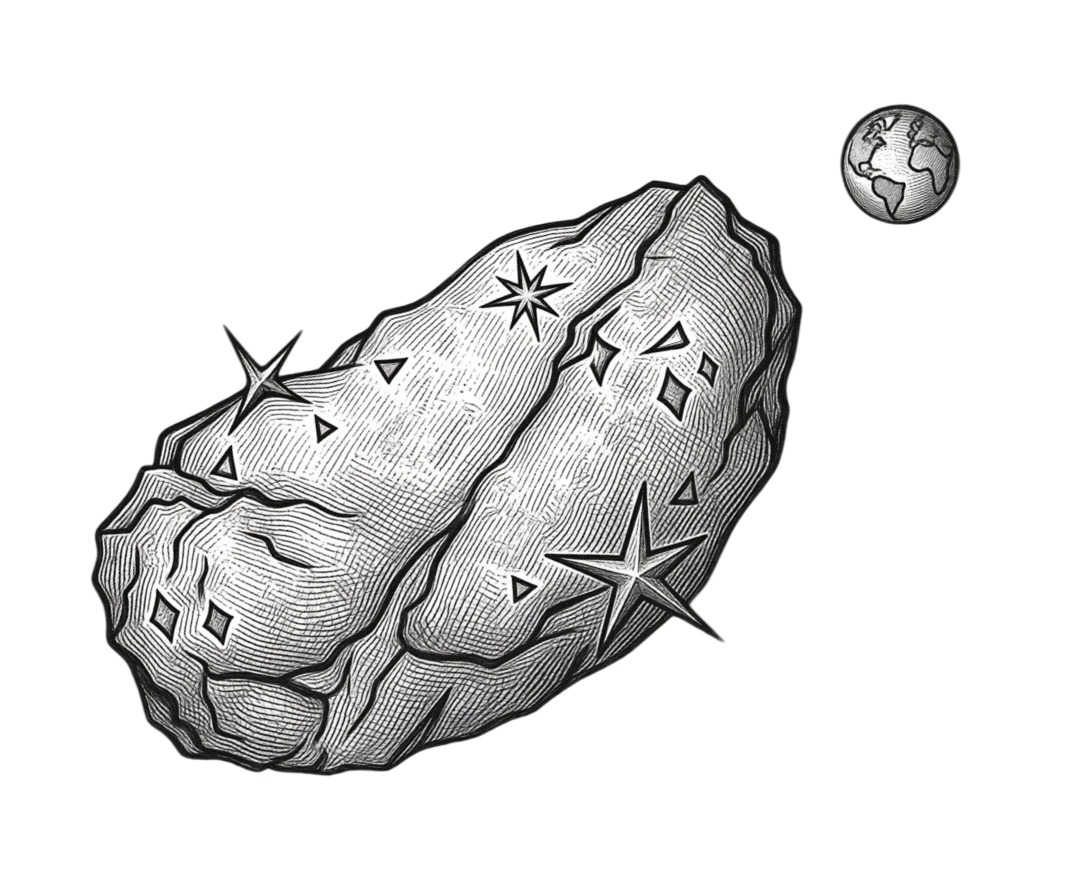
There is an asteroid drifting between Mars and Jupiter right now – 16 Psyche – that is estimated to be
made almost entirely of iron, nickel, and precious metals. Economists have placed its value at somewhere
around $10,000 quadrillion. That’s ten thousand followed by fifteen zeros. It’s a number so large it stops
feeling like a number and starts feeling like a philosophical problem.
The entire global economy is worth about $100 trillion. A single asteroid contains enough metal to make
every human being on Earth a billionaire roughly a hundred thousand times over.
So here’s the question that keeps aerospace lawyers, venture capitalists, geopolitical strategists, and
starry-eyed engineers all awake at night: who gets to go get it?
The solar system is made of money we can’t reach yet
Let me give you the geology first, because the geology is the reason everything else is happening.
Space is not empty. It is stuffed, absolutely stuffed, with resources – but distributed in ways that make
Earth’s mineral wealth look like a child’s piggy bank. The asteroid belt alone contains an estimated 700
quintillion dollars worth of minerals. Individual near-Earth asteroids have been catalogued and found to
contain platinum-group metals worth more than all the platinum ever mined in human history. The
Moon’s south pole holds what scientists now estimate to be billions of tonnes of water ice, locked in
permanently shadowed craters that haven’t seen sunlight in billions of years. Mars sits on enormous iron
oxide deposits and its thin CO₂ atmosphere can, in principle, be converted into rocket propellant through a process called In-Situ Resource Utilization (ISRU).
Why do these resources matter so much, right now? Two reasons colliding at exactly the wrong moment.
First: the green energy transition on Earth requires staggering quantities of rare earth elements, cobalt,
platinum, and lithium. Electric vehicle batteries, wind turbine magnets, solar panel components – the
materials we need to decarbonize civilization are exactly the materials that are scarce and unevenly
distributed on Earth, and whose extraction causes significant environmental harm. We face the uncomfortable reality that solving climate change requires mining, and mining at scale is destructive. The
asteroids offer a way out of that trap, in theory.
Second: the cost of reaching space has collapsed. SpaceX’s Falcon 9 reduced the per-kilogram cost to low
Earth orbit by roughly 90% compared to legacy launch systems. Starship, if it achieves its projected
capabilities, could reduce it by another 90%. The economics of space resource extraction, which looked
like science fiction in 2010, look merely very difficult in 2026. That’s enormous progress.
The legal vacuum that’s scarier than the physical one
Here is where the story gets genuinely unnerving, and where STEM meets political philosophy in a way
that should make you deeply uncomfortable.
The foundational document of international space law is the Outer Space Treaty of 1967, signed by 114
nations including all the major space powers. Article II states, with elegant brevity, that “outer space,
including the Moon and other celestial bodies, is not subject to national appropriation by claim of
sovereignty, by means of use or occupation, or by any other means.”
Outer space belongs to no one. It is, in the language of international law, the “common heritage of
mankind.”
So far so good. The problem is that the treaty was written before anyone seriously contemplated mining
space. It prohibits nations from claiming territory. It says nothing whatsoever about claiming resources
extracted from that territory. And as soon as money entered the equation, countries started exploiting that gap with the subtlety of a sledgehammer.
In 2015, the United States passed the Commercial Space Launch Competitiveness Act, which explicitly
grants American citizens and companies the right to own, sell, and profit from resources they extract from
space. Luxembourg – yes, Luxembourg, which has apparently decided to become the Delaware of space
mining – passed similar legislation in 2017 and began actively recruiting space mining companies to
establish themselves there. The UAE, Japan, and the UAE have all moved in similar directions.
The 1979 Moon Agreement, which attempted to establish a more rigorous “common heritage” framework
requiring shared international governance of lunar resources, has been ratified by exactly 18 countries.
The United States, Russia, China, and the European space powers have all refused to sign it. It is,
effectively, dead.
What we have right now is a legal framework that looks like this: you cannot plant a flag on an asteroid
and call it yours. But you can land on it, extract everything of value, bring it home, sell it, and pocket
every dollar. The asteroid itself is theoretically “common heritage.” The platinum you dug out of it is
apparently yours to keep.
This is not a stable situation.
The science of getting there
Before we go any further into the politics, let’s talk about the engineering, because it’s spectacular and not discussed nearly enough.
The core challenge of asteroid mining isn’t finding the asteroids – we know where thousands of near-Earth asteroids are, and the catalog grows daily. It isn’t even getting there, though that’s expensive. The core challenge is processing materials in microgravity, with no atmosphere, at temperature extremes ranging from -170°C in shadow to +120°C in sunlight, hundreds of millions of kilometers from any supply chain.
The proposed methods are genuinely inventive. For metallic asteroids like 16 Psyche, one approach
involves optical mining – focusing concentrated sunlight using mirrors to vaporize surface material, then
capturing the vapor as it re-condenses. For water-bearing asteroids and lunar ice, electrolysis can split
water into hydrogen and oxygen, which happen to be the most efficient rocket propellants known. An
asteroid-mined water depot in space would be transformative — refueling missions in orbit rather than
hauling propellant up from Earth’s gravity well would reduce mission costs by orders of magnitude.
The company AstroForge launched a test mission in 2023 specifically to trial asteroid refining in orbit —
not resource extraction yet, but the processing chemistry. NASA’s OSIRIS-REx mission returned samples
from asteroid Bennu in 2023 containing carbon-rich material and, excitingly, evidence of water-altered
minerals. Japan’s Hayabusa2 returned samples from asteroid Ryugu that have been yielding remarkable
mineralogical data. The scientific infrastructure for understanding what’s out there is being built right
now, mission by mission.
Lunar mining is arguably closer. NASA’s Artemis program has the explicit mandate to identify and
eventually utilize lunar resources. The LCROSS mission already confirmed water ice in the lunar south
pole. Several commercial lunar landers have been contracted to deliver prospecting instruments. The
Moon, at three light-seconds away rather than asteroid belt distances, is a far more tractable first target.
You could, in principle, establish a lunar base that mines water ice, electrolyzes it into propellant, and
sells that propellant to missions heading deeper into the solar system. The Moon as a gas station. The
geometry of orbital mechanics makes this sensible in ways that are hard to overstate.
So who actually owns it?
This is where I want you to sit with some real discomfort, because the answer is currently: whoever gets
there first, backed by whichever nation has the most permissive laws
The United States’ legal framework essentially creates a first-mover advantage protected by national law.
Any American company that extracts resources from an asteroid or the Moon owns those resources under
US law, and the US government will presumably back that claim diplomatically. China has its own lunar
ambitions – the Chang’e program has been landing on the Moon consistently and successfully, and
Chinese officials have explicitly discussed lunar resource utilization as a strategic objective. Russia has
historically opposed unilateral commercial frameworks, preferring international treaty structures, though
its space program’s capabilities have diminished significantly.
The scenario that concerns international law scholars the most goes something like this: American or
Emirati or Luxembourgian companies establish mining operations in the lunar south pole near the water
ice deposits. The good water ice locations are, due to orbital geometry, limited in number. Once the best
sites are occupied and operating, what happens when a Chinese mission arrives and wants to establish
operations nearby? Who mediates? What law applies? Is there a court with jurisdiction?
There is no court with jurisdiction. The Outer Space Treaty has no enforcement mechanism. There is no
space equivalent of the UN Security Council, and even if there were, we’ve seen how effective that body
is at resolving resource conflicts between great powers.
The resources question could become a genuinely serious geopolitical flashpoint within the lifetimes of
people reading this now.
The equity question nobody wants to answer
I want to raise one more thing that I think gets dangerously overlooked in the breathless coverage of
asteroid wealth.
The Outer Space Treaty declared space the “province of all mankind.” The Moon Agreement tried to
implement that principle concretely, specifying that space resources should benefit all countries,
particularly developing ones. Both the US and China rejected this framework. The emerging legal reality
is that space resources will benefit whoever has the technology and capital to extract them — which
means, overwhelmingly, wealthy nations and wealthy private companies
There are roughly 8 billion people on Earth. The development of space mining will be funded by capital
from perhaps a dozen nations, executed by companies operating under the laws of perhaps half a dozen
jurisdictions, and the profits will flow to shareholders and treasury departments that look nothing like a
representative cross-section of humanity.
Whether you find this troubling depends on your politics. But it’s worth noting that the Moon and the
asteroid belt got there the same way everything else in the solar system did from the same protoplanetary disk, built from the same stardust, without any human input whatsoever. The claim that a company incorporated in Delaware has a superior moral right to the platinum in 16 Psyche compared to, say, a farmer in Bangladesh or a village in the Sahel is not obvious. It requires argument. The argument hasn’t really been had yet, and the window for having it is closing.
Why I think it’s worth the chaos
Despite all of this, the legal vacuum, the geopolitical risk, the equity problems, I believe space resource
development is one of the most important things humanity could pursue right now. Let me tell you why,
and you can argue with me.
The alternative to mining asteroids for platinum is mining the Earth for platinum. And mining the Earth
for platinum, at the scale the green energy transition requires, means sacrifice zones in the Congo, in
South Africa, in Russia’s Norilsk region – places where the environmental and human cost of extraction is
already severe and will intensify. The asteroids are not inhabited. They contain no ecosystems. They will
not object to being mined. If we can get to them, we can potentially release Earth’s crust from the role of
the solar system’s only mineral repository.
Water ice on the Moon, converted to propellant in orbit, makes the entire solar system accessible at a
fraction of current cost. That includes asteroid deflection missions – our only real defense against the
occasional large space rock that wants to ruin everyone’s day. It includes deep space telescopes. It
includes, eventually, the capacity to spread life and consciousness to more than one fragile pale blue dot.
The governance problems are real. But the right response to a governance vacuum is to build governance, not to leave the resources untouched until a geopolitical accident makes the whole thing a crisis.
The Outer Space Treaty was written in 1967, when space was a frontier visited only by governments
racing to plant flags. We need a new framework – one that’s genuinely international, that has real
enforcement mechanisms, that grapples honestly with the equity question, and that allows commercial
development under rules everyone has agreed to. That framework is technically possible to build. It just
requires the same rare resource that every difficult collective action problem requires: political will.
We are, as a species, about to decide how we handle the largest resource frontier in history. It would be
nice if we thought carefully about it before the extraction begins.
-Written by Fida Wafiq
Want to go deeper?
- The Secure World Foundation publishes rigorous analysis on space governance.
- McGill Centre for Research in Air and Space Law has comprehensive resources on the legal frameworks.
- For the engineering side, NASA’s ISRU project pages and the journal Acta Astronautica are the places to start.