
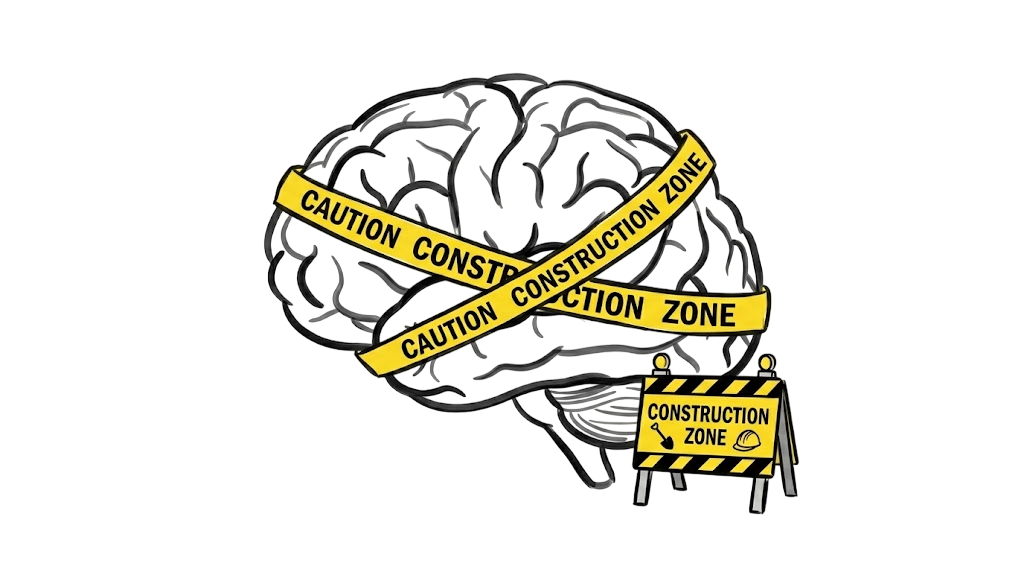
For most of human history, we believed the adult brain was fixed. A closed system. A machine that ran its
program and wore down. We were spectacularly wrong.
The story of how we discovered that is, honestly, one of the most exciting in all of neuroscience — and its
implications for how you live your life, train skills, recover from trauma, and even understand your own
identity are so staggering that I’m genuinely baffled it isn’t taught to every person on earth from
childhood.
The dogma that died slowly
For the better part of the 20th century, the scientific consensus on the adult human brain could be
summarized in one grim sentence: the neurons you’re born with are the neurons you die with, and they
only deteriorate.
This wasn’t fringe thinking. It was the mainstream position of neuroscience, articulated clearly by the
founder of the discipline himself. Santiago Ramón y Cajal, who won the Nobel Prize in 1906 for mapping
the brain’s cellular architecture, wrote that in adult nervous systems “the nerve paths are something fixed,
ended, immutable.” He meant it as a tragedy: the brain develops, peaks, and then simply ages. You
couldn’t rewire it any more than you could rewire a finished house.
The cracks in this consensus appeared slowly, then all at once.
In the 1940s, Canadian psychologist Donald Hebb proposed what would become one of the most famous
principles in neuroscience: neurons that fire together wire together. His idea, now called Hebbian
learning, suggested that the strength of connections between neurons could change based on use. Not the neurons themselves, but the synapses between them — the tiny gaps across which chemical signals jump from one cell to another. Use a connection enough, and it gets stronger. Leave it idle, and it weakens
Nobody had the tools to test this rigorously yet. But the seed was planted.
LTP: the molecular mechanism of memory
In 1973, Timothy Bliss and Terje Lømo published a paper that changed everything. Working with rabbit
hippocampal tissue, they showed that if you stimulate a synapse repeatedly and rapidly, the connection
doesn’t just fire — it becomes persistently stronger, sometimes for hours or days after the stimulation
ends. They called this Long-Term Potentiation, or LTP.
LTP is now understood to be one of the primary cellular mechanisms of learning and memory, and the
molecular story behind it is extraordinary.
Here’s what happens at the synapse level when you learn something. A neuron fires and releases
neurotransmitters — primarily glutamate — into the synaptic cleft. On the receiving side, two types of
receptors are waiting: AMPA receptors, which respond to normal signaling, and NMDA receptors, which
have a peculiar property. They’re blocked by a magnesium ion that can only be displaced if the
post-synaptic neuron is already active at the same time.
This makes the NMDA receptor a molecular coincidence detector. It only opens — only allows calcium to
flood in — when the pre-synaptic neuron is firing AND the post-synaptic neuron is already active. Both
sides must participate simultaneously. When this happens enough times, the calcium influx triggers a
cascade of biochemical signals that result in more AMPA receptors being physically inserted into the
post-synaptic membrane. The synapse becomes literally, structurally stronger. More receptors, more
sensitivity, faster and more reliable transmission.
This is what memory looks like at the molecular scale: a synapse that got used enough to build itself up.
The inverse also exists — Long-Term Depression (LTD) — where low-frequency activation of the same
pathway causes receptors to be removed and connections to weaken. Use-it-or-lose-it is not a metaphor. It is a molecular fact.
The hippocampus that launched a thousand papers
The hardest version of the “adult brain is fixed” dogma was the claim that no new neurons were ever
generated after birth — a concept called neurogenesis. If LTP shook the consensus, the discovery of adult
neurogenesis in the late 1990s detonated it.
In 1998, researchers Peter Eriksson and Fred Gage published findings from human subjects showing that
new neurons were actively being born in the adult hippocampus — the brain region most associated with
forming new memories and spatial navigation. The cells weren’t just surviving: they were integrating into
existing neural circuits and functioning. New neurons, in adult human brains, doing real cognitive work.
The scientific community’s initial reaction ranged from skepticism to outright disbelief. Thirty years of
textbooks were wrong.
We now know that adult neurogenesis occurs specifically in two brain regions: the hippocampus and the
olfactory bulb. The extent and functional significance of human adult neurogenesis is still debated — it’s
genuinely harder to study in living humans than in rodents — but the existence of it is no longer in
question.
What drives it? Exercise is the most robustly documented factor. Aerobic exercise — specifically the kind
that increases heart rate and keeps it elevated — dramatically increases the production of a protein called
BDNF (brain-derived neurotrophic factor), which functions essentially as fertilizer for new neurons and
synaptic connections. The hippocampi of people who regularly run or cycle are measurably larger than
those of sedentary people. Stress, conversely, suppresses neurogenesis — chronic cortisol exposure
actively kills hippocampal neurons and shrinks the region. Sleep is when consolidation happens:
memories formed during the day are replayed and strengthened during specific sleep stages.
This is not self-help messaging. It is mechanistic neurobiology.
The London cab drivers and the elastic cortex
The most iconic piece of evidence for neuroplasticity in action — the one that makes it viscerally real —
is the study of London taxi drivers.
In London, becoming a licensed cab driver requires passing “The Knowledge” — a notoriously grueling
test that requires memorizing the layout of over 25,000 streets, thousands of points of interest, and the
optimal routes between hundreds of pairs of locations. Preparation typically takes two to four years of
intensive study. Candidates cycle the routes repeatedly, building a mental map of extraordinary density
and detail.
In 2000 and again in 2011, neuroscientist Eleanor Maguire and colleagues at University College London
used MRI to compare the brains of licensed London cab drivers against non-drivers and against London
bus drivers (who follow fixed routes and don’t need to navigate). The results were striking: experienced
cab drivers had significantly larger posterior hippocampi than either control group. The more years a
driver had been on the job, the larger the region.
The hippocampus is the brain’s navigation center and spatial memory hub. The demands of The
Knowledge had physically expanded it.
This is neuroplasticity made visible. Not a metaphor, not a self-help talking point — a measurable
structural change in the brain tissue of adults, driven by what those adults spent years doing with their
minds.
The critical windows — and why adults aren’t locked out
Neuroplasticity is not uniform across a lifetime. Children’s brains are more plastic — they learn languages
without accents, recover from injuries that would be catastrophic in adults, and form foundational sensory
and social maps during what developmental neuroscientists call critical periods. The visual cortex has a
critical period early in life; if visual input is disrupted during that window (by a cataract, for example),
normal vision can fail to develop even after the cataract is removed.
This led to a simplistic but persistent narrative: young brains are plastic, adult brains are fixed. The reality
is considerably more nuanced.
Adult brains retain substantial plasticity — it’s just different in character. Rather than the sweeping
reorganization possible in infancy, adult plasticity tends to be more targeted, more experience-dependent, and more influenced by attention and motivation. The brain changes more where you direct focused attention. This is why deliberate practice — the kind where you’re operating near the edge of your current ability, getting immediate feedback, and correcting errors — is so much more effective than mindless repetition. Attention is not just psychological effort; it is a neurological signal that tells the brain this is worth encoding.
The neurotransmitter dopamine plays a key role here. When you experience reward or surprise — when
something meaningful happens — dopamine release modulates synaptic plasticity, essentially flagging
those neural patterns as worth keeping. This is why emotional salience aids memory. It’s why you
remember where you were when you heard important news but can’t recall what you had for lunch three
weeks ago. Dopamine literally tells your synapses to lock in what just happened.
What gets changed, and what stays put
It’s worth being precise about what neuroplasticity actually means and doesn’t mean, because the popular conception has gotten ahead of the science in ways that generate both excessive optimism and excessive confusion.
Neuroplasticity is not infinitely malleable. It does not mean you can rewire your brain to anything you
want with sufficient willpower and a good morning routine. The changes that are most robustly
documented are changes in synaptic strength, cortical map organization, and to a more limited extent,
neurogenesis in specific regions. These are real and significant. They do not mean that fundamental
personality structures, early trauma responses, or severe neurological damage can be wished away
through positive thinking.
What neuroplasticity does mean, practically and scientifically, is this: the brain is a dynamic organ that
changes in response to experience, and those changes are not trivial. Skilled musicians develop expanded
motor and auditory cortex representations for their instrument. Blind individuals use visual cortex for
tactile reading of Braille. Stroke survivors can sometimes reroute functions around damaged tissue as
surrounding regions are recruited. People who meditate for decades show measurable differences in
cortical thickness in regions associated with attention and interoception.
The changes take time. They require repetition and depth of engagement, not casual exposure. And they
are easier when the learning system — sleep, BDNF, attentional focus, reduced chronic stress — is
operating well.
None of this is magic. All of it is mechanistic. And the mechanism is more interesting than the magic ever
could be.
Why this is one of the most important scientific facts you can know
Here’s my honest conviction about neuroplasticity: the widespread cultural ignorance of this science costs
people enormously.
The implicit belief that people are fixed — that intelligence is a static quantity you either have or don’t,
that adults can’t meaningfully learn new skills, that damaged psyches stay damaged, that you’re basically
done becoming yourself sometime in your mid-twenties — this belief is not just wrong. It is actively
harmful. It stops people from attempting difficult learning. It leads clinicians to underestimate patient
recovery potential. It shapes educational policy in ways that abandon children labeled “low ability” before
their brains have finished their most rapid developmental windows.
The science says something different. Your hippocampus grows when you navigate. Your motor cortex
expands when you practice an instrument. Your prefrontal cortex — the seat of executive function,
decision-making, and impulse control — continues developing into your mid-twenties and remains
responsive to training throughout adulthood. Cognitive behavioral therapy works partly because it literally changes the pattern of activity in specific brain regions. Trauma leaves physical traces in neural
architecture, and targeted interventions can modify those traces.
None of this is effortless. None of it is fast. But the ceiling is higher than most people believe it is, and the
floor — the capacity of a damaged or undertrained brain to recover and grow — is higher than the old
dogma ever admitted.
Your brain is making connections right now, as you read this. Some of them, if you engage deeply
enough, will still be there tomorrow. That’s not poetry. That’s LTP. And I think it’s one of the most
astonishing things about being alive.
-Written by Fida Wafiq
Want to go deeper?
- Soft-Wired: Michael Merzenich’s work is a rigorous and readable treatment of adult neuroplasticity, exploring the brain’s ability to reorganize itself throughout life.
- The Molecular Basis of Memory: Eric Kandel’s Nobel lecture provides an extraordinary overview of the molecular biology behind how we remember, available online for deep study.
- The London Taxi Driver Papers: Eleanor Maguire’s original research papers on the structural brain changes in London taxi drivers are accessible through PubMed.
- The Brain That Changes Itself: Norman Doidge’s book captures many landmark cases of neuroplasticity in a popular tone, beautifully illustrating the brain’s incredible adaptability.