Artemis II will carry four humans farther from Earth than anyone has traveled in over fifty years — and
the secret to getting them home is pure physics.
There is a moment in every NASA mission plan that looks, to the untrained eye, like a mistake. The
spacecraft swings close to the Moon — not to land, not to orbit, but to whip around it like a stone in a
sling and then hurtle back toward Earth without firing a single engine. It looks reckless. It is, in fact, one
of the most elegant maneuvers in the history of spaceflight. This is the free-return trajectory. And it is at the heart of Artemis II, NASA’s upcoming crewed mission that will loop four astronauts around the Moon and bring them safely home — a feat not accomplished since Apollo 17 splashed down in 1972.
“NASA isn’t just going back to the Moon. They’re going back smarter — letting gravity do the heavy
lifting.”
Stealing gravity, legally
When people hear that NASA is “using the Moon’s gravity” to save fuel, it sounds like a metaphor. It isn’t.
As the Orion spacecraft approaches the Moon on its outbound leg, lunar gravity tugs at it — accelerating
it, curving its path, and then, as it swings around the far side, flinging it back in the direction of Earth. No
engine burn required for the return journey. The Moon does the work for free. The maneuver works because of a beautifully inconvenient truth in orbital mechanics: gravity never stops. The Moon’s gravitational field doesn’t end at its surface. It extends outward for hundreds of thousands of
kilometers, quietly reshaping the path of anything that passes nearby. Mission planners don’t fight this
force — they choreograph it.
The Three-Body Problem, simplified: At its core, the free-return trajectory balances three gravitational
pulls at once — Earth’s, the Moon’s, and the kinetic momentum of the spacecraft itself. Get the entry
angle and speed right, and the math resolves into a natural loop. The crew returns to Earth without a
single engine burn for the homeward leg. Get it wrong, and you’re doing a lot of frantic calculations in
deep space.
Why this matters more than you think
Free-return trajectories aren’t just fuel-efficient — they’re a safety net embedded in the laws of physics. If
every engine on Orion went dark on the way to the Moon, the crew would still come home. Gravity would
bring them back. This wasn’t hypothetical for the Apollo program. In April 1970, an oxygen tank aboard Apollo 13 exploded two days into the mission. The lunar landing was scrubbed. The crew — Lovell, Haise, and Swigert — had very little engine power and a damaged spacecraft. They survived because mission
controllers were able to leverage a modified free-return trajectory to slingshot them around the Moon and back to Earth. The physics caught them when the technology failed.
Artemis II won’t be taking that risk — but it is built with the same principle baked in. The mission’s
trajectory is designed so that even in an emergency, the spacecraft’s path will naturally curve back toward
Earth. In a program where the variables of deep space are genuinely unpredictable, that’s not a small
thing.
What Artemis II actually is
Artemis II is the first crewed flight of the Orion spacecraft and the Space Launch System, the most
powerful rocket NASA has ever built. It won’t land on the Moon — that’s Artemis III’s job. Instead, it’s a
dress rehearsal conducted at lunar distance: a roughly ten-day mission that will take its four-person crew
on a loop around the Moon, reaching a point about 9,000 kilometers beyond the lunar far side before
turning for home.
That makes it, by a significant margin, the farthest any human being has traveled from Earth since
December 1972. The crew will see the Moon’s surface from closer than any living person ever has.
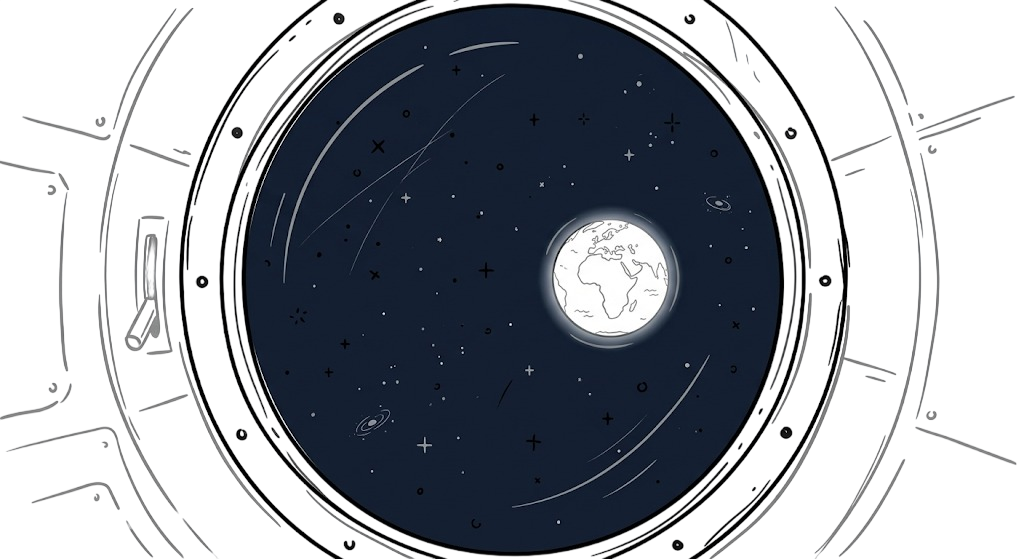
They’ll watch Earth shrink to a marble in the window. And then, right on schedule, the Moon’s gravity
will catch their spacecraft, curve its path, and send them home. “The crew will watch Earth shrink to a marble — and then, right on schedule, the Moon will send them
home.”
The physics of the perfect loop
To understand why this works, think of space not as an empty void but as a topography — a landscape of
invisible hills and valleys shaped by the mass of every object in it. Earth sits at the bottom of a deep
gravitational well. The Moon sits at the bottom of a shallower one. In between, there’s a point where the
two wells balance: the L1 Lagrange point, where a spacecraft can sit (theoretically) without being pulled
toward either body.
The free-return trajectory is essentially a path that threads through this landscape. The spacecraft climbs
out of Earth’s well, crosses the gravitational ridge, dips into the Moon’s well just enough to be redirected,
and then coasts back down into Earth’s well on the other side. No engines. Just geometry and gravity
doing exactly what Newton said they would, three centuries ago. The engineering challenge isn’t understanding the physics — it’s hitting the numbers precisely enough that it all works out. Entry angle, speed, timing: every variable has to be right to within fractions of a degree and meters per second. That’s what NASA’s trajectory teams spend months calculating. The Moon doesn’t give second chances at this distance.
Why it’s worth caring about
Artemis II is easy to frame as a milestone, and it is. But the deeper story is about how much physics
matters in human spaceflight. Every decision in a mission like this, from the shape of the trajectory to the
angle of reentry, is constrained and enabled by the same forces that govern the motion of galaxies. The
engineers don’t invent solutions out of whole cloth; they negotiate with the universe, finding the paths it’s
already prepared to allow. The free-return trajectory is a perfect example. NASA isn’t defying nature to bring those four astronauts home. They’re following it – very, very carefully.
Written by Fida Wafiq