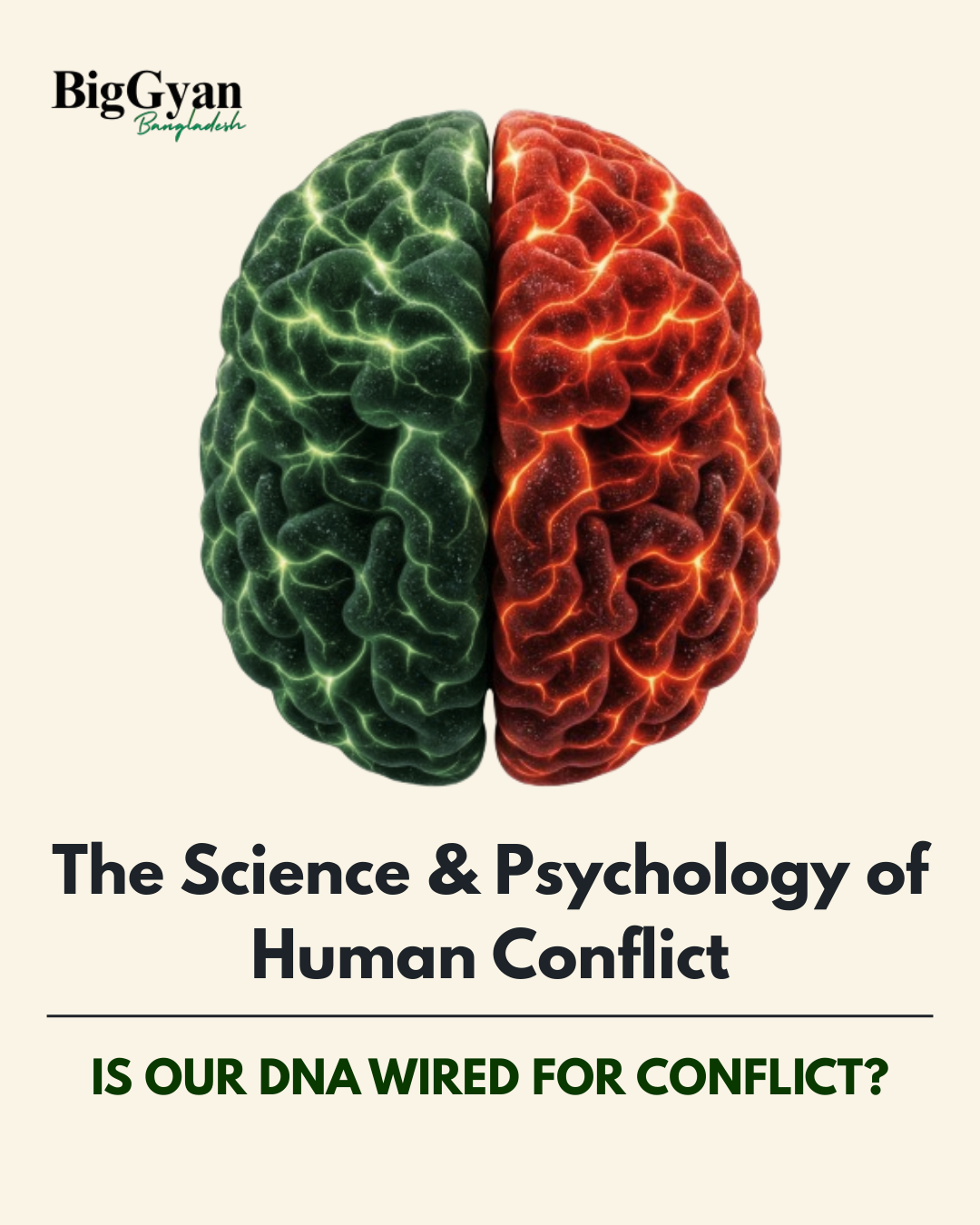
There is a question that has haunted philosophers, generals, and scientists for millennia, one that becomes more urgent with every war, every street argument, every comment section meltdown: Why do we do this to each other?
Conflict, in its many forms, is one of the most persistent features of human existence. And yet, for most of history, our explanations for it were largely moral or political — questions of good and evil, justice and greed. Today, science offers something far more unsettling: conflict isn’t an aberration. In many ways, it’s a feature.
Hardwired for Competition: The Evolutionary Argument
To understand why humans fight, you have to go back — way back.
Evolutionary psychology proposes that many of our behavioural tendencies were shaped by the environments our ancestors navigated over hundreds of thousands of years. In those environments, competition wasn’t optional. Resources — food, water, shelter, mates — were finite. Groups that cooperated internally and competed aggressively externally were more likely to survive and reproduce.
This gave rise to what researchers call parochial altruism: the tendency to be deeply cooperative and self-sacrificing toward in-group members, while being hostile or indifferent to outsiders. Studies of hunter-gatherer societies and observations of our closest primate relatives, chimpanzees, show consistent patterns of inter-group violence alongside tight in-group bonding.
The disturbing implication? Some of our social instincts that feel most virtuous — loyalty, solidarity, a fierce protectiveness of “our people” — may be the same instincts that make conflict between groups so persistent.
But evolution is not destiny. It sets a range of possibilities; culture, institutions, and individual choice determine where within that range we actually land.
Your Brain on Conflict: The Neuroscience of Aggression
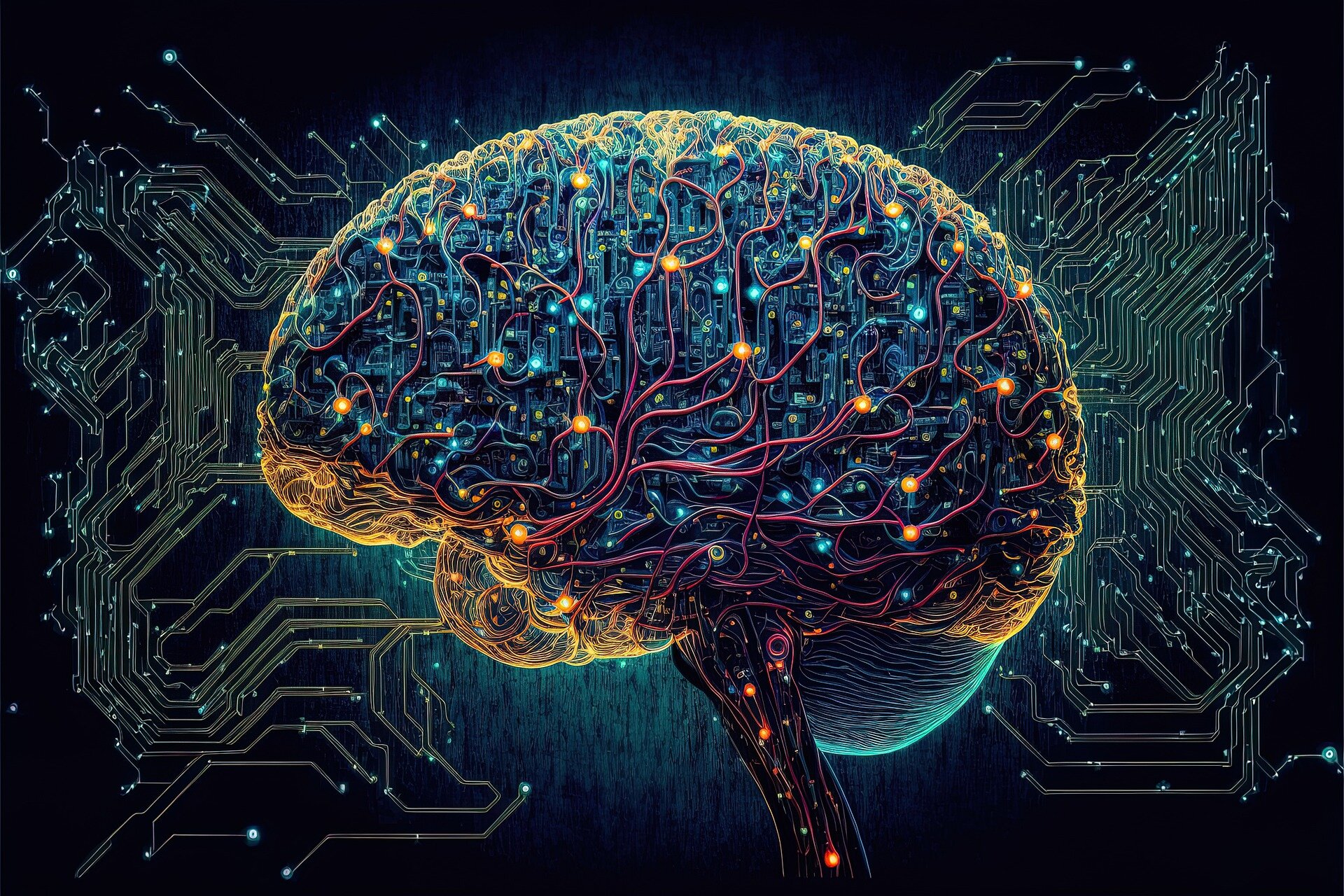
Aggression is not a single thing happening in a single place in the brain. It is a complex, multi-system phenomenon — and modern neuroscience has started to map it with remarkable precision.
The amygdala, an almond-shaped structure deep in the brain’s temporal lobe, plays a central role. It is the brain’s threat-detection system, processing fear and triggering fast, automatic responses to perceived danger. When the amygdala fires, it can override slower, more deliberate reasoning — the “act first, think later” circuitry.
Restraining that impulse is the job of the prefrontal cortex (PFC), the brain region responsible for planning, consequence evaluation, and impulse control. Research has consistently found that individuals and populations with lower PFC activity relative to amygdala reactivity show higher rates of impulsive aggression. Developmental studies reveal that the PFC doesn’t fully mature until the mid-twenties — a fact that casts adolescent risk-taking and conflict in a new light.
Neurotransmitters further complicate the picture. Serotonin generally acts as a brake on aggression; low serotonin is associated with increased impulsivity and hostility. Dopamine, often framed as the “reward chemical,” plays a role in how we perceive dominance and status — making social slights feel neurologically similar to physical threats. Meanwhile, testosterone influences dominance-seeking behaviour and has been shown to heighten sensitivity to perceived disrespect, though its relationship to aggression is far more nuanced than popular culture suggests.
One landmark study by Mehta and Josephs (2010) found that testosterone’s effect on behaviour is heavily modulated by cortisol (the stress hormone). High testosterone combined with low cortisol predicted dominance-seeking; high testosterone combined with high cortisol predicted anxiety rather than aggression. Context, in other words, matters enormously — even at the hormonal level.
The “Us vs. Them” Problem: Social Identity Theory
In 1971, British psychologist Henri Tajfel ran a now-famous experiment. He randomly divided schoolboys into groups, assigned them trivial labels (they were told they preferred paintings by either Klee or Kandinsky), and then asked them to allocate rewards between members of their own group and the other group.
The results were striking: the boys consistently favoured their own group, even when doing so meant smaller absolute rewards for everyone. They had no prior relationship with their group members, no shared history, no real stakes — and yet group membership alone was enough to generate bias.
This was the foundation of Social Identity Theory: the idea that our sense of self is deeply tied to the groups we belong to, and that we are motivated to see our groups positively. In-group favouritism and out-group devaluation emerge almost automatically from this dynamic.
Scale this up from schoolboys to nations, ethnic groups, political parties, or online communities, and the implications become sobering. Conflicts are rarely purely rational disputes over material interests. They are often identity conflicts — battles over recognition, status, and the symbolic meaning of group membership.
This is why conflicts can persist long after the original material grievance has been resolved, and why “rational” negotiation so often fails: you cannot address a wound to identity with a spreadsheet.
The Logic of Escalation: Game Theory and the Conflict Trap
If conflict is so costly, why does it happen between actors who know it is costly? This is the question that Game Theory was built to answer.
The Prisoner’s Dilemma is the field’s most famous thought experiment. Two suspects are held separately and offered the same deal: betray your partner and go free (while they serve a long sentence), stay silent and risk betrayal, or both stay silent and serve a short sentence. The individually rational choice is to betray. But if both follow individual rationality, both end up worse off than if they had cooperated.
This structure — where individual rationality produces collectively irrational outcomes — maps onto a shocking range of real conflicts: arms races, price wars, political brinkmanship, even neighbourhood disputes. Each actor, responding rationally to uncertainty about the other’s intentions, makes choices that make everyone worse off.
The key variable is trust. Nobel laureate Thomas Schelling showed that conflicts often arise not because actors want to fight, but because they cannot credibly communicate their intentions. Miscommunication, misread signals, and commitment problems can lock rational actors into conflict spirals that none of them wanted.
This insight has practical power: many of the most effective conflict-prevention mechanisms in history — from arms control agreements to diplomatic hotlines to formal treaties — are essentially trust-building technologies. They exist to solve the information problem that game theory identifies.
The Material Roots: Resources, Scarcity, and Climate
Psychology and neuroscience explain the mechanisms of conflict; they don’t fully explain its timing and geography. For that, we need to look at the material conditions that create pressure.
The relationship between resource scarcity and conflict is well-documented. A 2007 meta-analysis of civil war onset found that countries heavily dependent on natural resource extraction were significantly more prone to civil conflict — the so-called “resource curse.” Rather than generating shared prosperity, resource windfalls often fuel competition between armed groups and undermine state legitimacy.
Water is increasingly identified as the resource most likely to drive future conflict. Approximately 2 billion people currently live in water-stressed regions, and projections suggest this figure will grow substantially as climate change disrupts precipitation patterns and glacial melt. Already, tensions over shared river systems — the Nile, the Mekong, the Indus — are generating geopolitical friction among nuclear-armed states.
The climate-conflict link is one of the most actively debated areas in conflict studies. A landmark 2013 paper in Science (Hsiang et al.) found statistically significant associations between temperature anomalies and increased rates of personal violence and inter-group conflict across time periods and societies. The proposed mechanism is partly economic (heat damages crops and productivity), partly neurological (heat increases physiological arousal and irritability), and partly social (resource stress strains institutions).
The Science of Peace: What Actually Works
The most important implication of all this science is not that conflict is inevitable — it’s that the conditions for conflict are identifiable and, in principle, modifiable.
Contact Theory, developed by Gordon Allport in 1954, proposes that prejudice and inter-group hostility can be reduced by structured contact between groups under the right conditions: equal status, cooperative goals, institutional support, and genuine personal interaction. Hundreds of studies have since supported and refined this idea. Programs bringing together Israeli and Palestinian youth, or former combatants in post-conflict societies, have shown meaningful reductions in hostility — though the effects are more fragile than advocates once hoped.
Institutional design is another lever. Political scientists Douglass North, John Wallis, and Barry Weingast argued in their influential work that the fundamental challenge of social order is managing the incentive to use violence. Societies that build “open access orders” — with rule of law, independent courts, competitive politics, and economic opportunity — dramatically reduce the returns to violence and replace conflict with competition through legitimate channels.
At the interpersonal level, negotiation science has developed robust frameworks. Harvard’s Program on Negotiation developed the concept of interest-based bargaining: rather than arguing over positions (“I want X”), parties explore the underlying interests that drive those positions, which are often more compatible than the surface demands suggest. This approach has been applied in everything from hostage negotiations to international border disputes.
The Uncomfortable Conclusion
The science of human conflict delivers a message that is simultaneously humbling and hopeful.
Humbling, because it suggests that conflict is not a failure of reason or a temporary aberration. It is woven into our evolutionary history, encoded in our neurobiology, structured into our social psychology, and amplified by material conditions. There is no simple cure, no switch to flip.
Hopeful, because it reveals that conflict is not random. It has identifiable causes, predictable escalation pathways, and known de-escalation mechanisms. The same science that explains why we fight also illuminates how institutions, norms, and deliberate design can alter the conditions under which conflict flourishes — or fails to take hold.
The question isn’t whether human beings are capable of conflict. Clearly, we are. The more interesting, and more urgent, question is this: Given everything we now know, what are we going to build?
– written by Fida Wafiq
Want to go deeper? The following are worth your time:
- The Better Angels of Our Nature — Steven Pinker (2011)
- Behave: The Biology of Humans at Our Best and Worst — Robert Sapolsky (2017)
- The Origins of Virtue — Matt Ridley (1996)
- Hsiang, S.M., Burke, M., & Miguel, E. (2013). “Quantifying the Influence of Climate on Human Conflict.” Science, 341(6151).
- Tajfel, H. & Turner, J.C. (1979). “An integrative theory of intergroup conflict.” In W.G. Austin & S. Worchel (Eds.), The Social Psychology of Intergroup Relations.