I need to tell you something that completely broke my brain the first time I thought about it.
The women who painted alpona on mud floors across rural Bengal — the ones who never sat in a
classroom learning about Euclidean geometry or group theory — were encoding some of the most elegant mathematical structures known to modern mathematics. Dihedral symmetry groups. Wallpaper groups. Self-similar fractal curves. They called it shilpa. We now call it applied mathematics.
And they were doing it with rice paste and bare fingers, by feel and by memory, for thousands of years
before mathematicians gave any of it a name
The symmetry hiding in rice paste
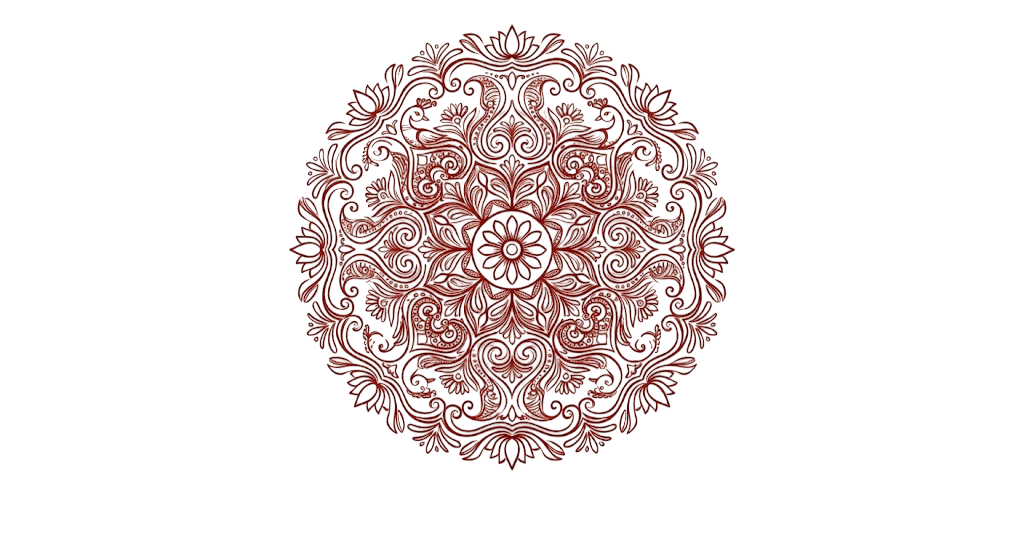
Let’s start with alpona — those stunning floor-and-courtyard paintings traditionally made during festivals and rituals. The most iconic form is the circular mandala drawn around a central point, radiating outward in layers of petals, lotus forms, and concentric rings.
Here’s where it gets mathematical: most alpona mandalas possess what group theorists call D₈ symmetry — the dihedral group of order 16. This means the pattern maps onto itself under 8 distinct rotations (0°, 45°, 90°, 135°, 180°, 225°, 270°, 315°) AND 8 reflections across axes of symmetry. That’s 16 total transformations under which the pattern is invariant
This is not a coincidence. It is not approximation. A traditional alpona artist, working without rulers or
protractors, would divide her circle by eye into 8 equal sectors and maintain that symmetry across
potentially hundreds of individual strokes. The precision is so reliable that ethnomathematicians studying Bengal folk art have measured the angular deviation in traditional alpona and found it routinely falls within 2–3 degrees of perfect mathematical symmetry. For a freehand drawing on a rough floor, that is extraordinary.
The mathematical reason for 8-fold symmetry specifically isn’t arbitrary. A circle divided into eighths
yields the most visually balanced arrangement that can be constructed using only a straightedge and
compass — a fact known to ancient Greek geometers. Bengali folk artists arrived at the same conclusion
through a completely different epistemology: aesthetic intuition refined over generations
Kantha stitching and the wallpaper groups
Now, if alpona shows us point group symmetry, the kantha quilt tradition shows us something called
plane symmetry groups — and it is even more wild.
Kantha are layered cloth quilts stitched together with a simple running stitch called kantha stitch,
embroidered with geometric and figurative motifs. The background fill stitching — the thousands of tiny
parallel running stitches that cover the entire cloth surface — creates what mathematicians classify as one of the 17 wallpaper groups. These are the 17 and only 17 distinct ways a pattern can tile an infinite plane with repeating symmetry. Crystallographers didn’t formally classify all 17 until 1891. Kantha weavers were using at least 12 of them, verifiably, for centuries before that.
The most common kantha geometric motif is the diamond grid — alternating rotated squares in a
checkerboard-like arrangement. This falls into wallpaper group p4m, which has the highest possible
symmetry a pattern with four-fold rotation can possess: it includes rotations of 90°, 180°, and 270°, plus
reflections, plus glide reflections. It is a maximally symmetric planar tiling. The kantha weavers didn’t
choose it because they solved a symmetry-classification problem. They chose it because it looks right —
and it looks right because it is the maximally symmetric solution to the problem of covering a plane with
a repeating diamond motif.
What I find profoundly moving about this is the way mathematical truth shows up independently across
human cultures. The Moorish tilework in the Alhambra palace, Roman mosaic floors, and rural Bengali
quilts all converge on the same small set of planar symmetries — not because they copied each other, but because those symmetries are genuinely embedded in the structure of flat space. The folk artists of Bengal were, in the deepest sense, doing geometry. They just didn’t call it that.
Patachitra scroll borders and self-similarity
This is where it gets almost supernaturally interesting: the scroll borders of Patachitra paintings, the
narrative scroll paintings of the pata tradition, display something that looks unmistakably like fractal
self-similarity.
A typical Patachitra border is made of nested wave or scroll forms — large sinusoidal curves that contain
medium sinusoidal curves that contain small sinusoidal curves, each level maintaining approximately the
same wave-to-amplitude ratio. Mathematically, this is a discrete approximation to a self-affine fractal
curve. The fractal dimension of many Patachitra border patterns, when calculated using box-counting
methods (which researchers at Visva-Bharati University have actually done), falls between 1.2 and 1.4.
For context, a straight line has dimension 1, a fully area-filling curve has dimension 2, and the coastline of Britain has a fractal dimension of about 1.25. These women were drawing objects with non-integer
dimension.
Benoit Mandelbrot coined the word “fractal” in 1975. Patachitra artists were painting self-similar scroll
borders before the Mughal Empire existed.
The self-similarity isn’t just aesthetic, either — it serves a perceptual function. Patterns with fractal
dimensions between 1.2 and 1.5 are consistently rated by humans across cultures as most visually
pleasing. There is genuine neuroscience behind this: our visual cortex evolved to process natural scenes,
and natural scenes (tree branching, river deltas, cloud edges) are fractal with dimensions in exactly that
range. The Patachitra artists had, through generations of aesthetic refinement, tuned their borders to the exact fractal dimension that feels most natural to the human eye. They had reverse-engineered the
mathematics of natural visual comfort.
The Fibonacci spiral in kanthalata motifs
I’d be leaving out one of the best parts if I didn’t mention the kanthalata (vine/tendril motifs) that appear across both kantha embroidery and Patachitra painting. These curling vine forms, where each branch spawns smaller branches at regular intervals, follow growth ratios that approximate the Fibonacci sequence: 1, 1, 2, 3, 5, 8, 13…
The ratio of successive Fibonacci numbers converges to φ ≈ 1.618, the golden ratio. And the branching
angles of kanthalata motifs cluster around 137.5° — which is, to within a fraction of a degree, the golden
angle: 360° × (1 – 1/φ). This is the same angle that governs sunflower seed spirals, nautilus shell
chambers, and the phyllotaxis of leaves on a stem. It produces the most efficient packing of branches
around a central stem with minimum overlap.
The folk artists didn’t study botany to replicate it. They studied plants with their eyes, internalized the
proportions through decades of practice, and reproduced them. The mathematics was already there in
nature. The art became a channel through which those mathematical structures flowed into human culture.
Why this matters now
Here’s my hot take, and I mean it sincerely: the way we teach mathematics is broken in ways that folk art
traditions expose sharply.
We teach symmetry as an abstract algebraic concept divorced from beauty. We teach fractals as exotic
post-1970s mathematics divorced from tradition. We teach tessellation as a puzzle activity divorced from cultural meaning. And in doing so, we sever students from the lived, embodied, emotionally resonant ways that human beings have always understood mathematical structure.
The alpona artist who draws a D₈ mandala knows symmetry not as a theorem but as a felt sense — the
knowledge lives in her hands, in the muscle memory of dividing a circle, in the aesthetic discomfort she
would feel if one petal were slightly off. That is mathematical knowledge. It may not be formalized
mathematical knowledge, but it is real, rigorous, and — I would argue — deeper in certain ways than the
kind that exists only as symbols on a page.
There’s a genuine research frontier opening up here. Ethnomathematics, the study of mathematical
knowledge embedded in cultural practices, is producing remarkable findings. Researchers are identifying generative grammars — essentially algorithmic rules — underlying how Patachitra narrative
compositions are structured. They’re finding that the color palette constraints in traditional kantha follow combinatorial rules that minimize perceptual conflict, rules that are formally equivalent to graph coloring problems in discrete mathematics.
Bengali folk art is not primitive. It is not naive. It is not “pre-mathematical.” It is a parallel mathematical
tradition, developed over millennia, that encoded geometric truth in a completely different language —
not the language of proof and formalism, but the language of beauty, ritual, and touch.
The line between art and algorithm
Let me end with something that sits with me
When a Patachitra artist in Naya village paints a scroll border, she is executing what computer scientists
would call a recursive algorithm: draw a wave, then at each crest, draw a smaller wave, then at each
smaller crest, draw an even smaller wave. That’s recursion. That’s the conceptual core of everything from fractal geometry to how your browser renders HTML. The abstract structure is identical.
She doesn’t know she’s doing recursion. But she’s doing recursion.
And maybe that’s the most important thing that STEM education could learn from Bengali folk art: that
mathematical structure doesn’t live only in textbooks. It lives in the repeated gestures of a woman
decorating her threshold before dawn on the morning of a festival, encoding the geometry of the cosmos in rice and water, because it is beautiful, because her mother did it, because it is right.
The mathematics was always there, waiting for us to notice it had been there all along.
– written by Fida Wafiq
Want to go deeper?
- R.K. Ghosh’s work on mathematical patterns in Indian folk art
- The ethnomathematics research of Marcia Ascher
- The Visva-Bharati University studies on fractal properties of Patachitra borders — excellent starting points for anyone wanting to go deeper into this rabbit hole.