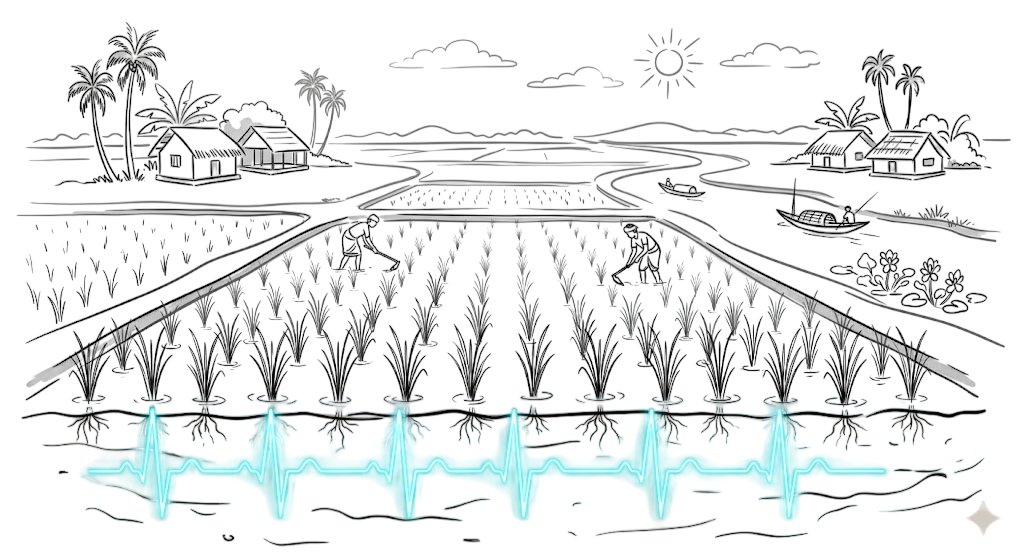
Ever stood in the middle of a paddy field in the height of the monsoon, watching the sky turn
that heavy, bruised purple, wondering if the rains will be a blessing for the crop or a death
sentence for the season? For generations, our farmers have relied on an ancient, intuitive
dance—reading the wind, feeling the humidity, and watching the behavior of the birds. It is a
beautiful, deeply human science. But as 2026 unfolds, we are witnessing a new layer added to
that wisdom: a digital heartbeat that doesn’t replace the farmer’s intuition but amplifies it.
Welcome to the era of “Digital Krishi.” Across the Delta, from the salt-stressed coastal belts of
the south to the fertile plains of the north, we are moving away from blanket guesswork toward a
precision-based, data-driven agriculture that treats every square meter of soil as a unique entity.
The Myth of the “Robot Farmer”
There is a common fear in the tech world that automation is meant to replace the human
element. In the context of Bangladesh, this couldn’t be further from the truth. Our farming culture
is defined by smallholder families who live and breathe their land. The “Silicon-to-Soil”
movement of 2026 isn’t about replacing the farmer with a robot; it’s about giving the farmer a
“digital co-pilot.”
Think of it as moving from an analog watch to a smartwatch. The time is still the same, but you
suddenly have the pulse of your health on your wrist. Our farmers are now receiving the “pulse”
of their land on their smartphones.
The Sensors: Reading the Soil’s Language
The revolution starts beneath the surface. In 2026, we are seeing the rollout of affordable,
ruggedized IoT (Internet of Things) sensor networks designed specifically for our climate. These
aren’t delicate, expensive lab instruments; they are simple, solar-powered probes installed in the
soil to monitor moisture, salinity, and nutrient levels in real-time.
In the southern districts like Satkhira or Bagerhat, where salinity intrusion is a daily struggle,
these sensors are a game-changer. Previously, a farmer might notice their rice yield dropping
and assume it was a pest problem or poor seed quality. Now, the sensor alerts their phone: “Soil
salinity at threshold. Activate specific irrigation management.” This allows the farmer to flush the
salt or adjust water usage before the crop is damaged. We aren’t fighting nature; we are finally
learning to listen to it.
The Intelligence Layer: Predictive Resilience
The data collected from these sensors, when paired with satellite imagery and local weather
modeling, creates an “Advisory Intelligence” system. This is where 2026 has really hit its stride.
Instead of waiting for a radio broadcast that may be too general, a farmer receives a push
notification on their phone: “Heavy rainfall expected in 48 hours for your sub-district. Consider
clearing drainage channels now to prevent water logging.” This isn’t science fiction—it is the
deployment of hyper-local climate models that turn a disaster-prone landscape into a managed,
resilient one. By providing this information, we are shifting the farmer’s role from reactive (fixing
problems after they happen) to proactive (mitigating risks before they arrive).
The Economic Shield: Why This Matters Now
The most compelling argument for the digital transformation of our agriculture is economic
sovereignty. We face soaring costs for fertilizers, pesticides, and seeds. Precision agriculture
helps us optimize these inputs.
When you apply fertilizer only where the sensor indicates a deficiency, rather than across an
entire field, you save money—and the environment. This “input optimization” is not just efficient;
it’s a direct boost to a family’s profit margins. In 2026, we are seeing that startups that provide
these “digital extension services” are helping smallholders increase productivity by up to
30-40%. For a farmer, that is the difference between surviving and thriving; it is the difference
between sending a child to school or pulling them out for labor.
The “Zero-Volt” Philosophy: Building for the Delta
Just as our recent shift to sodium-ion batteries proved that we don’t need to copy the West’s
“lithium-first” model, our approach to smart farming must be our own. We aren’t building
sprawling, industrial-sized, sensor-laden corporate farms. We are building a “micro-precision”
model: small, accessible, and community-focused.
We are utilizing mobile-first platforms that prioritize voice, local dialect, and low-bandwidth
connectivity, ensuring that the technology is accessible even in the most remote haor or char
lands. This is technology that respects our geography, our climate, and our people.
We are utilizing mobile-first platforms that prioritize voice, local dialect, and low-bandwidth
connectivity, ensuring that the technology is accessible even in the most remote haor or char
lands. This is technology that respects our geography, our climate, and our people.
The Verdict: A Smarter Delta
The story of STEM in 2026 isn’t about grand, alien technologies. It is about the elegant
integration of the digital and the biological. It is about empowering the farmer with the data to
master their environment.
As we look toward the rest of the year, the mission is clear: we are building an agricultural
system that is future-ready. By digitizing the soil, we are ensuring that the Delta remains the
lifeblood of our nation for generations to come. We are not unplugging from tradition; we are
plugging it into the future.
The future of the Delta is bright, it’s resilient, and it’s smarter than ever.
– written by Abrar Sayeed
Want to go deeper?
- The 2026 Smart Agri-Census — Explore the data on the 40% uptick in digital advisoryadoption in rural Bangladesh this year.
- The Salinity Defense — A technical breakdown of how IoT-guided irrigation is savingcoastal rice yields.
- The “Digital Krishi” API — How local developers are creating open-source tools for smallholder farmers.
- Climate Resilience Framework (2026) — Understanding how satellite-linked alerts are preventing harvest loss during the monsoon.