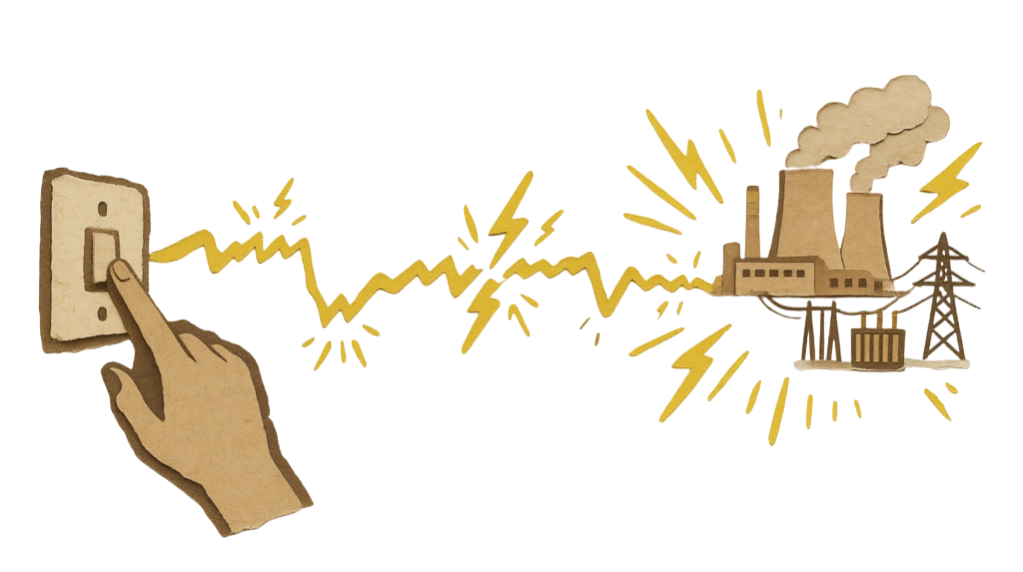
It happens in a fraction of a second. You walk into a dark room, flip a plastic switch, and the lights instantly hum to life. We do it dozens of times a day without a second thought. It feels like magic, but that simple flick of the wrist physically connects you to the largest, most complex, and most delicately balanced machine ever built by humanity: the electrical power grid.
When you flip that switch in a Dhaka apartment, you are instantly demanding energy from a power plant that might be hundreds of kilometers away.
But how do those electrons actually get to you? Why do we have massive steel towers crisscrossing the countryside? And what exactly is happening behind the scenes when the lights suddenly cut out during a summer load-shedding event?
Let’s trace the journey of an electron and decode the anatomy of the power grid.
Phase 1: Generation (The Engine of the Grid)
Where motion becomes electricity.
Almost all the electricity in the world is generated by a single, foundational principle discovered by Michael Faraday in 1831: electromagnetic induction. Faraday found that if you move a magnet near a coil of copper wire, it forces the electrons in the wire to move.
A modern power plant is essentially just a giant machine designed to spin a massive magnet inside a massive coil of wire. But how do you spin it?
- In a thermal power plant (which generates the majority of Bangladesh’s electricity using natural gas or coal), fuel is burned to boil water. This creates high-pressure steam that blasts through a turbine, spinning it at incredible speeds.
- In a hydroelectric plant (like the Kaptai Dam), flowing water physically pushes the turbine blades.
As this massive turbine spins the magnet, it pushes and pulls electrons in the surrounding copper coils. It pushes them one way, then pulls them back, over and over. This creates Alternating Current (AC). In Bangladesh, this push-and-pull cycle happens exactly 50 times every second, giving the grid a frequency of 50Hz.
Mind-Blowing Fact: The electrons from the power plant don’t actually travel all the way to your house. Because it is Alternating Current, the electrons just vibrate back and forth in place, passing the energy down the line like a wave traveling through the ocean.
Phase 2: Transmission (The High-Voltage Highways)
Why power lines are so dangerous—and so necessary.
Once the electricity is generated, we have to move it to the cities where people live. But here, engineers face a massive physics problem: electrical wires have resistance.
As electricity travels through a wire, the resistance of the metal causes some of the electrical energy to turn into heat. If we tried to send regular household voltage across the country, all the energy would burn off as heat before it ever reached the city.
To solve this, we rely on a bit of math. Electrical power is the product of voltage and current (P = VI). However, the power lost to heat in the wires is determined by Joule’s First Law, which states that power loss is proportional to the square of the current:
P_{loss} = I^2R
Notice that the lost power depends heavily on the current (I). If we can lower the current, we drastically lower the lost heat. So, right outside the power plant, the electricity is fed into a step-up transformer. This device massively increases the voltage (often up to 132kV, 230kV, or even 400kV) while simultaneously dropping the current.
This high-voltage, low-current electricity is then sent along the massive steel transmission towers you see along the highways. The high voltage is why those lines are placed so high up in the air—if they were too close to the ground, the electricity could literally arc through the air and strike the earth.
Phase 3: Distribution (The Final Mile)
Taming the voltage for your living room.
As those high-voltage lines approach a densely populated city like Dhaka, the electricity is far too dangerous to bring directly into neighborhoods. It needs to be tamed.
- The Substation: The high-voltage lines first route into a substation (a fenced-off yard filled with large, humming equipment). Here, step-down transformers lower the voltage to a safer, but still deadly, 11kV or 33kV.
- The Feeder Lines: This medium-voltage electricity travels along the wooden or concrete poles lining the main streets of the city.
- The Local Transformer: Finally, before the power enters your home, it hits one last transformer—usually a gray, cylindrical metal can mounted on a pole near your street. This steps the voltage down one final time to a usable, safe 220V.
From there, it flows through the meter box, into your home’s circuit breaker, and waits patiently behind your wall switches.
The Balancing Act: The Physics of Load Shedding
We cannot talk about the power grid without addressing the elephant in the room: power outages.
Why does load shedding happen? It stems from a fundamental limitation of our current technology: electricity cannot easily be stored on a massive scale.
The power grid is a real-time machine. The exact amount of electricity being consumed by a country must be matched by the exact amount of electricity being generated at that exact second.
Imagine it is a sweltering summer afternoon. Millions of people get home from work and turn on their air conditioners at the same time. The demand for electricity spikes drastically. When demand is higher than the power plants can supply, it acts like a physical brake on those giant spinning turbines at the power plant. The grid’s frequency starts to drop below 50Hz.
If the frequency drops too much, it can cause catastrophic damage to the generators, leading to a complete, uncontrollable collapse of the entire national grid (a total blackout that could take days to fix).
To prevent this disaster, grid operators have to intentionally disconnect certain neighborhoods from the grid to instantly reduce demand and bring the system back into balance. That purposeful, controlled disconnection is load shedding. It is a defensive maneuver to save the larger machine.
The Ultimate Engineering Marvel
The next time you plug in your phone or turn on a fan, take a moment to think about what is actually happening. You are participating in a synchronized dance of physics and engineering.
A turbine hundreds of miles away is spinning at blistering speeds, pushing a wave of electromagnetic energy through transformers, up into towering high-voltage lines, across rivers and fields, down through urban substations, and straight into your walls—all in real-time, just because you flipped a switch.
-Written by Abrar Sayeed
Want to go deeper?
- “The Grid: The Fraying Wires Between Americans and Our Energy Future” by Gretchen Bakke: A fascinating deep dive into how power grids were historically built, why they are so fragile, and how renewable energy is forcing us to rethink them completely.
- Physics of Transformers (Faraday’s Law of Induction): Brush up on the fundamental physics of how alternating current allows us to manipulate voltage using magnetic fields.
- The Smart Grid Revolution: Look into how modern EEE researchers are developing “smart grids” that use IoT sensors and AI to predict power surges and prevent load shedding before it happens.